15 Fat 85 Lean Beef Burgers
Ground beef, minced beef or beefiness mince is beefiness that has been finely chopped with a knife or a meat grinder (American English) or mincing machine (British English language). It is used in many recipes including hamburgers, bolognese sauce, meatloaf, meatballs and kofta.
It is not the aforementioned as mincemeat, which is a mixture of chopped dried fruit, distilled spirits, spices and historically (but nowadays rare) minced/footing meat.[one]
Contents [edit]
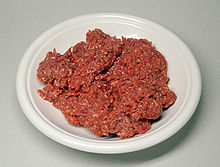
In many countries, nutrient laws define specific categories of basis beef and what they can contain. For example, in the United States, beef fatty may exist added to hamburger simply non to footing beef if the meat is ground and packaged at a USDA-inspected plant.[note 1] In the U.S., a maximum of 30% fatty by weight is allowed in either hamburger or ground beef. The allowable amount in France is v to 20% (15% being used by most food chains). In Germany, regular basis beef may contain up to 15% fat while the special "Tatar" for steak tartare may incorporate less than v% fatty. Both hamburger and footing beef can have added seasoning, phosphate, extenders, or binders added, but no boosted h2o is permitted. Basis beef is often marketed in a range of unlike fat contents to match the preferences of customers.
Ground beef is generally made from the less tender and less popular cuts of beef. Trimmings from tender cuts may also be used.[ii]
In a study in the U.S. in 2008, eight brands of fast nutrient hamburgers were evaluated for recognizable tissue types using morphological techniques that are commonly used in the evaluation of tissue's histological status.[3] The study of the eight laboratory specimens found the content of the hamburgers included:
- H2o: 37.7% to 62.4% (mean, 49%)
- Musculus: 2.1% to 14.8% (median, 12.1%)
- Skeletal tissue: "Bone and cartilage, observed in some brands, were not expected; their presence may be related to the use of mechanical separation in the processing of the meat from the beast. Small amounts of bone and cartilage may have been detached during the separation process."
- Connective tissue
- Blood vessels
- Peripheral nerve tissue. Brain tissue was not detected in whatever of the samples.
- Adipose tissue—"The corporeality of lipid observed was considerable and was seen in both adipose tissue and as lipid aerosol. Lipid content on oil-scarlet-O staining was graded equally 1+ (moderate) in 6 burgers and 2+ (marked) in 2 burgers."
- Plant material: "was likely added as a filler to give bulk to the burger"
"Pink slime" [edit]
Ground beefiness in the United States may comprise a meat-based product used as a food condiment produced using engineering known as avant-garde meat recovery systems or alternatively by using the slime organisation. Meat processing methods used by companies such every bit Beefiness Products, Inc. (BPI) and Cargill Meat Solutions produce lean, finely textured beef product, otherwise known as "pink slime," from fatty beef trimmings. This meat-based product is then treated with antimicrobial agents to remove salmonella and other pathogens, and is included in a variety of ground beef products in the U.S.[4] From 2001, the United States Department of Agriculture (USDA) has approved the production for limited human consumption. In a 2009 commodity by The New York Times, the prophylactic of the beefiness processing method used by BPI was questioned.[5] Subsequently the USDA'southward approval, this production became a component in ground beef used by McDonald's, Burger King and many other fast-food chains as well as grocery bondage in the U.Southward.[5]
In regime and industry records in testing for the schoolhouse dejeuner program, pathogens such as Due east. coli and salmonella were found dozens of times in meat from BPI, which raises questions well-nigh safe of the meat production and the effectiveness of the antimicrobial method used in meat recovery organisation of the visitor. Between 2005 and 2009, E. coli was establish three times and salmonella 48 times.[v] BPI had a charge per unit of 36 positives for salmonella per ane,000 tests, compared to a rate of nine positives per 1,000 tests for other suppliers for the programme.[v] However, the programme continued to source from BPI because its price was substantially lower than ordinary meat trimmings, saving well-nigh $1m a year for the program.[5] Cargill, among the largest hamburger makers in the U.S., is a big buyer of the meat-based product from BPI for its patties, according to the Times.[v] It suspended ownership meat from two plants owned by BPI for several months in 2006 after excessive levels of salmonella were plant.[5]
Cuts of beef [edit]
Although any cut of beefiness can be used to produce ground beef, chuck steak is a popular choice because of its rich flavor and balance of meat-to-fat ratio. Round steak is too ofttimes used. Footing beef is usually categorized based on the cut and fat percentage:[vi]
- Chuck: 78–84% lean
- Round: 85–89% lean
- Sirloin: 90–95% lean
Culinary use [edit]
Ground beef is popular equally a relatively cheap and quick-cooking form of beef. Some of its best-known uses are in hamburgers, sausages and cottage pies. It is an of import ingredient in meatloaf, sloppy joes, porcupine meatballs, tacos, and Midwestern cuisine.[vii] It tin can be used to make meat sauces, for example, lasagna and spaghetti bolognese in Italian cuisine. In the Center Eastward, information technology is used to make spicy kofta and meatballs. The Scottish dish mince and tatties uses it with mashed or boiled potatoes. In Lancashire, particularly Oldham, minced meat is a mutual filling for rag pudding. The Dutch slavink consists of footing meat (one-half beefiness, one-half pork) rolled in salary.
Raw, lean, ground beef is used to make steak tartare, a French dish. More than finely diced and differently seasoned, information technology is popular every bit a main form and as a dressing in Belgium, where information technology is known as filet américain ("American fillet").
Food condom [edit]
Food safety of footing meat is problematic; bacterial contamination occurs often. Undercooked hamburgers contaminated with Due east. coli O157:H7 were responsible for four deaths in the U.S. in 1993 and hundreds of people brutal ill.[8] Ground beef must be cooked to 72 °C (160 °F) to ensure all bacterial contamination—whether it exist endogenous to the product or contaminated after purchasing by the consumer—is killed. The colour of cooked meat does non e'er signal the beef has reached the required temperature; beefiness can dark-brown before reaching 68 °C (155 °F).[9]
To ensure the safe of nutrient distributed through the National Schoolhouse Lunch Program, food banks, and other federal food and nutrition programs, the United States Department of Agriculture has established nutrient safety and quality requirements for the footing beef it purchases. A 2010 National Research Council written report reviewed the scientific footing of the Department'south ground beef safety standards, compared the standards to those used by large retail and commercial food service purchasers of ground beef, and examined means to establish periodic evaluations of the Federal Purchase Ground Beef Plan.[10] The report constitute that although the safe requirements could exist strengthened using scientific concepts, the prevention of future outbreaks of foodborne diseases will depend on eliminating contamination during production and ensuring meat is properly cooked before it is served.[x]
The 2013 horse meat scandal (Horsemeatgate) found traces of horsemeat in many UK and European foods and ready meals which were labelled as being minced/footing beef products generally.
Run into also [edit]
- Ground meat
- Patty
- List of hamburgers
- Meatball
Notes [edit]
- ^ These rules simply apply to meat beingness sold across state lines. In the U.S., much footing beef is produced at local grocery stores and is not sold across state lines. In these cases, the laws of the local state apply; state laws may have different requirements.
References [edit]
- ^ Jaron (January 12, 2021). "Minced Meat Vs Ground Meat – What's The Difference?". Foods Guy . Retrieved July 16, 2021.
- ^ "Ground Beefiness and Food Prophylactic". Fsis.usda.gov. United states of america Department of Agriculture. August 6, 2013. Retrieved November 11, 2015.
- ^ Prayson, Brigid; McMahon, James T.; Prayson, Richard A. (2008). "Fast food hamburgers: what are we really eating?" (PDF). Annals of Diagnostic Pathology. Elsevier. 12 (half-dozen): 406–409. doi:10.1016/j.anndiagpath.2008.06.002. PMID 18995204. Archived from the original (PDF) on December 10, 2013. Retrieved April 8, 2014.
- ^ "Temperature Rules! - Cooking for Nutrient Service" (PDF). Fsis.usda.gov. U.s. Section of Agriculture. October 12, 2011. Archived from the original on October 18, 2011. Retrieved April 25, 2016.
{{cite web}}: CS1 maint: unfit URL (link) - ^ a b c d due east f g Moss, Michael (December 31, 2009). "Condom of Beef Processing Method Is Questioned". The New York Times . Retrieved Nov 11, 2015.
- ^ "Ground Beefiness Category Breakdown". BeefRetail.org. National Cattlemen'due south Beef Association. July xviii, 2009. Archived from the original on July 18, 2009. Retrieved April 25, 2016.
{{cite web}}: CS1 maint: unfit URL (link) - ^ "Foods and Nutrition: Ground Beef" (PDF). Virginia Cooperative Extension Service.
- ^ DoD Joint Grade in Communication, Grade 02-C, Squad ane. "Case Study: Jack in the Box E. coli crisis". The Academy of Oklahoma. Retrieved April 8, 2014.
{{cite web}}: CS1 maint: multiple names: authors list (link) - ^ "FSIS Directive - Safe and Suitable Ingredients Used in the Production of Meat, Poulty, and Egg Products" (PDF). Fns.usda.gov. United States Section of Agriculture. March nine, 2010. Archived from the original on March 9, 2010. Retrieved April 25, 2016.
{{cite spider web}}: CS1 maint: unfit URL (link) - ^ a b "An Evaluation of the Food Safety Requirements of the Federal Purchase Ground Beef Program". Dels.nas.edu. National Academy of Sciences, Division on Earth and Life Studies. 2010. Archived from the original on March 19, 2011. Retrieved November 11, 2015.
External links [edit]
 | Look up ground beef in Wiktionary, the free dictionary. |
- Footing Beef Condom
Source: https://en.wikipedia.org/wiki/Ground_beef
0 Response to "15 Fat 85 Lean Beef Burgers"
Post a Comment