Mystic Arts During the Time of Rome That Are Similar to Christianity
Religion in The Roman World
An essay by Marianne Bonz describing the myriad of religious options available in the Roman Empire.
Bonz is managing editor of Harvard Theological Review. She received a doctorate from Harvard Divinity School, with a dissertation on Luke-Acts as a literary challenge to the propaganda of imperial Rome. She has published several articles on the status of Jews in the Greek province of the Empire and on the developing religious bulletin of the Roman emperors.
Early Christian preachers such as the Apostle Paul brought the gospel near Jesus Christ to an empire already crammed full of deities. The citizens of the Roman empire and, within certain limits, fifty-fifty its rulers were extremely tolerant of foreign gods. The oldest and most accustomed group of foreign deities were the gods of aboriginal Greece. These gods had fabricated their home in the Roman world at an early time, along with Greek fine art and literature. Some of these Greek gods shared Roman names and caused some Roman characteristics. Just many others were but accepted as they were.
The Gods of Mountain Olympus
Co-ordinate to Greek mythology, when the sons of Cronus divided the universe amongst themselves, Zeus received the regions in a higher place the world, Poseidon claimed the vast regions of body of water as his domain, and Hades was given the regions beneath the earth. Just, except for Hades, who preferred his underworld domain, information technology was agreed that the clouds above Mt. Olympus should be the common habitation identify of all the gods.
Assembled on Mt. Olympus, the gods formed a kind of extended family unit, an exclusive lodge, with its own laws and hierarchy. Offset came the twelve great gods and goddesses: Zeus, Poseidon, Hephaestus, Hermes, Ares, and Apollo; Hera, Athene, Artemis, Hestia, Aphrodite, and Demeter. Not part of this original twelve only placed with them were several other deities, the most of import of whom are Helios and Selene (the dominicus and the moon) and Dionysus.
As the showtime among equals, the mighty Zeus ruled over this ofttimes contentious and somewhat dysfunctional Olympian family. These gods were thought of every bit resembling people, except they were much bigger, more powerful, and usually more than cute. Like mortals, they experienced emotions, such as dear, detest, acrimony, and jealousy. Merely unlike mortals, their bodies always healed from the wounds of war or the ravages of disease, and they never aged. The gods also possessed the ability to change themselves into all fashion of disguises, including those of animals and inanimate objects.
Zeus: Even in the ancient Greek poems of Homer and Hesiod, Zeus was the ruler of the gods, the most powerful and the most wise. But in these early on days, Zeus also was guilty of numerous sexual indiscretions with both goddesses and mortal women. These liaisons resulted in the birth of a number of demi-gods and heroes, for whom the Greeks likewise established cults. Despite his wisdom and majesty, this early Zeus could also be petty, self-indulgent, and occasionally cruel.
By the first century earlier the common era, nonetheless, his identity had merged with the more serious Roman god Jupiter. And this new Zeus/Jupiter was to become the supremely just, powerful, and even benevolent protector of the Roman empire. His will for his earthly subjects was often equated with divine providence or the unfathomable workings of Fate.
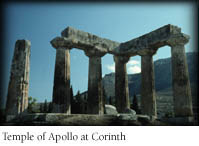 Apollo: Not to be confused with the sunday itself, which was represented past a special divinity, Helios, Apollo was nonetheless a solar god. Because the Mediterranean sun's rays strike the world similar darts, Apollo was thought of as an archer-god, whose arrows could either wound or heal. He was besides the god of vocal and the lyre, too every bit the god of divination and prophecy. His sanctuary at Delphi was one of the near sacred places in the Greek earth for revelation and estimation.
In the Iliad, Homer's epic narrative of the Trojan War, Apollo allied himself with the Trojans. Since Rome afterwards claimed the Trojans every bit their ancestors, it is perhaps not surprising that Rome'south first emperor, Augustus, placed his reign under Apollo's special protection. To reinforce his clan with the god, Augustus built a sanctuary for Apollo side by side to his palace on the Palatine hill in Rome. Later, the emperor Nero, who fancied himself a musician, would also claim a special association with Apollo.
 Artemis: Artemis was the twin sis of Apollo. Their mother was Leto, one of the many goddesses seduced by Zeus. Like Apollo, Artemis was a goddess of the hunt. She is commonly depicted as a kind of tomboy in curt tunic, conveying a bow and arrows. Also like her blood brother, who was associated with the light of the lord's day, Artemis was associated with the low-cal of the moon. Every bit such, in some regions she was besides considered the protectress of the tombs of the dead.
Very dissimilar in origin and appearance is Artemis of Ephesus, whose immense temple came to be known as one of the seven wonders of the aboriginal earth, and whose agog worshipers form the backdrop for one of the most dramatic encounters in the Book of Acts. This Artemis was a goddess of fertility and fecundity, who probably traveled to the area in and around Ephesus from barbarian regions further east.
Aphrodite: The daughter of Zeus past yet another minor female deity, Aphrodite was the personification of female person beauty. Although all of the Olympian goddesses were beautiful in their mode, only Aphrodite exuded charm and seduction. Although she may have originated as a fertility goddess, she is known primarily every bit the goddess of love. Her devotees ranged from unmarried girls and widows, seeking to obtain husbands, to courtesans, some of whom served in her temples. It is perhaps no surprise therefore that sailors were among her virtually frequent worshipers!
In the Roman earth she was also identified with the goddess Venus, the beautiful and seductive goddess who was the female parent of Aeneas, the founding hero of Rome co-ordinate to legend. Only since Julius Caesar, his nephew the emperor Augustus, and all of the Roman emperors downwards to Nero traced their own ancestry back to Aeneas and through him to Venus, her cult emphasized romantic, marital, and particularly maternal dearest.
Demeter: Of the twelve original Olympian deities, Demeter was probably the one who most affected the lives and fortunes of mutual people. She was the goddess of fertility and of the fruits of the harvest. She was worshipped throughout the Greek world and remained important to her Greek subjects even in the Roman royal era. She had the reputation of being attainable to the needs of mortals, on whom she bestowed the benefits of the world'south abundance.
Her main sanctuary was at Eleusis, in the country beyond the outskirts of Athens. And her cult centered on the reenactment of a story by means of which the Greeks explained the mysteries of the agricultural seasons--how the earth's vegetation seemed to die in winter, only to be reborn once again every bound.
In add-on to ii yearly festivals in which the cease of the harvest and the renewal of the planting were commemorated, a major festival was celebrated every five years. The principal object of this festival was the public veneration of Demeter and, for those who qualified, the celebration of her mysteries. Although Romans generally were not admitted to these cloak-and-dagger rites, the goddess wisely permitted a few. We know of at least two emperors who were initiated into her mysteries and who supported her cult with material gifts.
Since the proceedings of these mysteries and their rituals remained undercover, historians do not know exactly what transpired. It is known, however, that those who participated were granted some assurance of the connected favor of the goddess, both in this life and the side by side.
 Dionysus: Although not 1 of the original Olympians, the cult of Dionysus was very old and was celebrated throughout the Greek world and beyond. As the god of the vine and of the pleasures of its tillage, his cult became associated with that of Demeter at an early time. As with Demeter, his devotees ranged the entire spectrum of the social scale. Likewise, his cultic observance ranged from dignified ceremonies and parades to orgiastic celebrations and festivals.
Later Rome, fearing that these festivals would lead to civil unrest, attempted to suppress his cult, only it met with very lilliputian success. Although the Romans could not curtail the immense popularity of Dionysus, the god's appearance and the legends surrounding his worship did change dramatically over time.
Even though fairly early on in his history Dionysus's appearance inverse from that of a mature, bearded man of a decidedly rustic quality to a long-haired and somewhat effeminate adolescent with exotic attributes, throughout virtually of his history his essential character remained that of a mannerly rogue. He was depicted equally the god who brought the joys and ecstasies of the vine, as well as the fruits of civilization, and not only to Greece merely also to far-away India and Egypt. But Dionysus also could reduce even people of event to madness, if they crossed him.
During the Roman period a new legend developed concerning Dionysus, one that offers intriguing parallels to Christianity. According to this legend, Dionysus was killed while contesting the enemies of Zeus. His body was dismembered, just Zeus restored him to immortal life. Henceforth, according to the late first-century Greek philosopher Plutarch, Dionysus became a dying and rising god, and a symbol of ever-lasting life.
For all of their majesty and beauty, nonetheless, the Olympian deities seemed not to care about the lives of ordinary homo beings. And by the arrival of the common era, with the exception of Demeter and Dionysus, these gods had become largely formalism. The devotion of the average Greek or Roman centered on gods of lesser rank, gods who had once been mortal and who, therefore, understood the sufferings of mortals--gods who cared.
Miracles and Healing in the Roman World
In Matthew's gospel, Jesus' birth is heralded past the heavenly portent of a star ascension in the East, which guides certain wise men (or astrologers) who travel from a afar land to Bethlehem to see the future king (Matt 2:1-two). In all of the gospels Jesus performs numerous healings, and on several occasions he fifty-fifty brings the dead back to life. And in the Volume of Acts, a vision of the risen Jesus appears to Saul on the road to Damascus (Acts 9:i-7). As a event of this run into, Saul is converted and eventually becomes Paul, who devotes the rest of his life to the service of Christ.
Although all of these religious claims seem remarkable to the modern reader, none of them would have astounded the average citizen of the early Roman empire. Stories of heavenly portents, miraculous healings, mystical visions, and even resurrections were told about a number of demi-gods or heroes. In fact, a number of supernatural phenomena were even attributed to certain philosophers and emperors.
Omens and Portents: Roman historians such every bit Suetonius and Tacitus ofttimes reported the occurrence of miraculous omens or portents regarding the emperors, particularly at the beginning or end of their reigns. Because Rome placed its rulers at the superlative of human society, it was believed that they served equally mediators for the will of the gods on world. Accordingly, the appearance of omens, for good or ill, was the means past which the gods could bespeak the working of their volition in human affairs.
Afterwards the death of Julius Caesar, Suetonius (Lives of the Caesars: Julius 88) reports that at the funeral games held in his award "a comet shone for 7 successive days, rising about the eleventh hr, and was believed to exist the soul of Caesar, which had been taken into heaven." But information technology was Julius Caesar'south adopted son, the immensely popular and widely-revered emperor Augustus, who generated the most stories of this type. According to one story, Augustus'southward mother was worshipping in the temple of Apollo when she vicious asleep and was impregnated by the god (Suetonius Lives of the Caesars: Augustus 94). Another story also attested to Augustus's unusually close relationship to Apollo, the god of prophecy, past crediting the emperor with having divined beforehand the result of all of his wars (Suetonius Lives of the Caesars: Augustus 96).
Miracles: In the first century of the common era, renowned men could also be credited with having performed miracles. The popular emperor Vespasian (the former Roman general who had befriended the Jewish historian Josephus during the Commencement Jewish Revolt) was credited with having performed several miracles. Co-ordinate to stories recorded by the Greek historians Dio Cassius and Tacitus, Vespasian worked several healing miracles, while visiting the shrine of Sarapis in Arab republic of egypt. Amidst these miracles, Vespasian is credited with healing a blind man and restoring another man's crippled paw (Tacitus Histories iv.81).
But miraculous powers were non express to emperors, or even to people from the empire'south social and political elite. Miracles were a sign of a special human relationship between the gods and particular individuals. People who were thought to possess nifty wisdom or virtue were also oft credited with performing miracles.
One interesting example of a wonder-working, itinerant philosopher is that of Apollonius of Tyana. Apollonius was a late kickoff-century follower of the famous Greek philosopher, Pythagoras, whom some believed had go a god. Having renounced his possessions and worldly position in virtuous pursuit of divine wisdom, Apollonius was reputed to have led a disciplined and rigorously ascetic life.
According to his after biographer, Philostratus, Apollonius possessed boggling gifts, including innate cognition of all languages, the ability to foretell the futurity, and the ability to come across across swell distances. Apollonius's possession of divine wisdom also endowed him with the power to heal the sick and demon-possessed, and Philostratus narrates the miraculous quality of a number of these cures and exorcisms.
What all of these stories of wonder workers have in common is that (in contrast to magic, which is performed by charlatans for personal profit) miracles are performed past exceptional human beings, in the service of a god, for the skilful of other people.
In addition to mere homo beings, who were and then favored either because of their extraordinary power or their boggling wisdom and virtue, the world of the early Roman empire was likewise inhabited by another group of individuals who could serve as intermediaries between the gods in a higher place and the world below. These were the demi-gods or heroes, individuals of mixed parentage (human being and divine). They were usually credited with possessing boggling powers, while also possessing slap-up agreement of and compassion for the hurting and suffering of ordinary human beings.
In full general, their demi-god condition is expressed in the fact that they alive equally mortals; but when they die, they retain their fully vigorous human advent, likewise as their former powers. Considering of their unique status and qualities, in the pop imagination these demi-gods were frequently regarded as protectors. In the globe of the first century, Herakles (Hercules) and Asclepius were two of the about widely worshipped of these protector or "savior" gods.
Herakles: Co-ordinate to Greek fable, Herakles was the son of Zeus past a mortal woman of noble lineage, whose proper noun was Alcmene. Zeus'south vengeful married woman, Hera, attempted to kill the infant Herakles by placing serpents in the cradle where he and his twin brother slept. But Herakles strangled the snakes, thus saving himself and his twin.
In improver to semi-divine parentage and birth in difficult circumstances, some other mutual feature of the lives of demi-gods is that they run into ignominy or great misfortune, which they must either overcome before death or resolve through death. After he was grown and married, Herakles was struck with a deadly madness and, mistaking his own wife and children for those of a bitter enemy, he killed them. It was in atonement for this terrible crime that he performed the twelve superhuman labors that rid the globe of terrifying monsters and brought new security to the world's inhabitants.
Because of his superhuman strength, Herakles was the patron of athletes, and sanctuaries honoring him adorned virtually every gymnasium throughout the Greco-Roman world. Merely his most important function was that of powerful patron and protector of human beings and gods alike.
 Asclepius: The son of Apollo by a mortal woman, Asclepius was taken by his divine father at birth and apprenticed to a wise centaur (a mythical creature, half human and half equus caballus). This centaur, whose name was Chiron, taught Asclepius the healing arts so that he could reduce the sufferings of mortals. With his miraculous cures, Asclepius rapidly earned peachy fame. Motivated by compassion, he fifty-fifty succeeded in restoring the dead to life. Only this proved his undoing. Hades complained to Zeus that if this were allowed to continue, the natural lodge of the universe would exist subverted. Zeus agreed and struck Asclepius downwardly with a thunderbolt. In some versions of the story, Asclepius was transformed into a star after his death.
Asclepius was an immensely popular god, originally in Hellenic republic but later on also in Rome. By the fourth century earlier the common era, he had established a number of sanctuaries in Greece, the near important ones being in Cos and Epidauros. Early in the 3rd century BCE, his cult was brought to Rome after the urban center had been struck by a plague. Asclepius'due south medical knowledge and divine healing powers fostered 2 distinct traditions within the Greek world. On the one hand, he served as a divine mentor to the doctors who treated patients at his sanctuary at Cos. On the other paw, at the sanctuary of Epidauros, the god performed miraculous cures in response to the direct petitions of suppliants.
In the early Roman imperial era, Asclepius assumed an even greater religious importance. He had become a savior god. The physically or emotionally afflicted received long-term care and guidance at his sanctuaries, and in return they devoted themselves to his worship and service.
The most famous of devotee of Asclepius during the Roman imperial menses was the rhetor and sophist (professional public speaker) Aelius Aristides. Having just embarked on his public career, Aristides was stricken by a complete physical and mental breakdown. After seeking the assistance of some other god to no avail, he visited the shrine of Asclepius in his adoptive city of Smyrna.
During this visit, the god appeared to Aristides in a dream-vision, and this come across changed his life. Asclepius not just prescribed treatments for his chronic bouts of illness, the god too offered guidance for the conduct of all aspects of his life. Thereafter, Aristides placed himself and his career under the god'south protection, making numerous extended visits to the renowned Asclepius sanctuary in Pergamon. In his autobiographical narrative of his numerous encounters with the god, Aristides reveals his special relationship with Asclepius by most often addressing the god as "Savior."
Other Popular Savior Deities of the Early Roman Imperial Era
 Isis: Even though the oldest and nearly distinguished cults of the Roman imperial flow had originated either in aboriginal Greece or in Rome itself, a number of foreign cults imported from the more recently conquered territories of the empire had also developed large and enthusiastic followings. This was especially truthful of the Egyptian cult of Isis, which, along with the relatively new cult of her consort Sarapis, together with her son Horus and an array of lesser deities of exotic grapheme, had migrated start to Greece and then to Rome.
Originating in conjunction with her one-time husband Osiris as the personification of the divine power of the Pharaohs of aboriginal Egypt, Isis was worshipped continuously for thousands of years, before achieving her greatest renown in the early Roman empire. During this last menses, her cult presented i of the near formidable and enduring rivalries to early Christianity.
According to the ancient Egyptian fable, Osiris succeeded to the throne of Egypt when his divine begetter, Geb, retired to the heavens. His sister, Isis, became his queen. Osiris brought agricultural abundance to Egypt and introduced the arts of civilization. After some years of peaceful rule, he was cruelly murdered. But Isis recovered his torso and, with the assistance of Thoth (Wisdom) and Anubis (Guide of expressionless souls), she succeeded in restoring Osiris to life. Once resurrected from death, Osiris could take returned to rule over Arab republic of egypt. Instead he relinquished his throne to his son, Horus, preferring to rule over the kingdom of the dead.
Although in the myth of this early catamenia, Isis played merely a minor function, she gradually acquired an impressive listing of attributes for which she was widely venerated. In the 3rd century earlier Christ, Egypt was ruled by the Greek successors of Alexander the Great. It was they who essentially transformed the cult of Isis, replacing Osiris with a new divinity, Sarapis (an amalgamation of Osiris and another Egyptian god, Apis). Past taking this ancient Egyptian cult of the Pharaohs and making information technology their own, the new rulers sought to reconcile the country and its people to Greek control.
Gradually Isis and Sarapis divided between them all the powers of the universe. Sarapis, like the Greek god Zeus, with whom he was often identified, represented a divine majesty of universal scope, encompassing rulers and nations. But Isis was a savior and protector in a far more personal way. Gradually assimilating the most important characters and attributes of a number of goddesses native to Greece, her benefactions became virtually without limits.
Isis was worshipped every bit the divine impetus for the establishment of justice and the laws of human social club. She was also oft associated with the benefits of agriculture and the harvest. She was known to guide women through the dangers of childbirth. In one of several surviving hymns, written in the final centuries before Christ, Isis is credited with a knowledge of the nature of all things. In another, she is venerated equally the queen of every land.
This exceptional adoration is closely linked to her proven record of benefactions on behalf of ordinary people. Archaeologists have discovered a number of inscriptions in which a grateful worshiper has detailed the many gifts bestowed past the goddess, including healings and miraculous rescues from the perils of sea voyage.
Like Christianity, Isis's cult was spread by her followers, primarily to the port cities of the empire, by means of its trade and navigation routes. Also like Christianity, the cult of Isis grew from the bottom upward. By the dawn of the mutual era, her cult had become then widespread among the masses of the Roman empire that the emperor Augustus and his immediate successors were unable to suppress it, and they eventually gave up the try.
By the time of the devastation of Jerusalem and the writing of the Gospel of Mark, Isis had even get a patron deity of the Roman imperial family unit. Her cult, with its mysteries that promised conservancy to initiates, remained widely popular well into the early Christian era. In the following quotation from a Greek novel of the second century, CE, it is the goddess herself who speaks to an initiate who has earnestly sought her favor:
"Behold, Lucius. . . moved past your prayer I come up to y'all--I the natural mother of all life, the mistress of the elements, the first kid of time, the supreme divinity, the queen of the underworld, the first amid those in heaven--I, whose single godhead is venerated all over the earth under manifold forms, varying rites, and changing names. . . . Queen Isis.
"Behold, I take come to you in your calamity. I have come with solace and help. Away then with tears. Stop to moan. Ship sorrow fleeing. Soon through my providence shall the sun of your conservancy rise." (Apuleius, Metamorphoses 11.5)
Religion and the Roman Emperors
In the last century before the common era, the Greek cities had fallen prey to decadent Roman administrators and desultory local insurrections, as the ability struggles between rival Roman factions consumed the remaining vigor of the dying Roman republic. All of these struggles came to an finish when Octavian (who, as emperor, was given the name Augustus) defeated the forces of Mark Antony and Cleopatra at the battle of Actium.
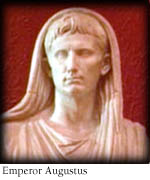 With the advent of the reign of Augustus in 27 BCE, life in the provincial cities of the Greek East became far more stable and prosperous than information technology had been for a very long time. The relief of the subject peoples was immense, and a number of the cities issued decrees honoring the new emperor as the earthly appearance of a benevolent god: "Providence. . .past producing Augustus [has sent] us and our descendants a Savior, who has put an end to state of war and established all things. . . ."
Such a response was not without precedent. Since the time of Alexander the Peachy, the Greeks had been accepted to giving their rulers divine honors. But with the advent of Augustus, the situation was unlike. As historian S. R. F. Price observes, the decrees honoring Augustus "brand explicit and elaborate comparisons between the actions of the emperor and those of the gods."
Furthermore, the worship of Augustus was not tied to specific benefactions or civic improvements. Rather, Augustus was worshipped throughout the empire equally the distributor of the whole world. The outpouring of praise, gratitude, and affection for this first emperor, who reigned at the time when Jesus was built-in, was undoubtedly genuine.
Information technology was Augustus's virtually unchallenged prestige and popularity that provided the impetus for establishing a cult of the emperors. And this cult, once established, provided standing support for the imperial governing authorization. Accordingly, from the very get-go, the cult of the emperors was a complete merging of organized religion and politics.
The Part of the Gods in the Care of the Empire and Its Ruler: With the exception of a few gods and goddesses who ministered to the private needs of individuals, the role of the Olympian deities was to care for the diverse aspects of the natural earth and of human social club. For example, Demeter was the goddess of grain and the harvest, Poseidon ruled over the seas, Athena was the goddess of wisdom, etc. It is perchance not surprising, therefore, that in the quaternary century BCE, when a immature and dashing Alexander the Great conquered all of the territory from Greece to Republic of india and bestowed the gifts of Greek culture and culture on the barbarian regions under his armies' control, in the popular listen he became associated with the youthful version of Dionysus--the god who was too believed to have traveled from Greece to Republic of india spreading the fruits of cultivation and civilization.
Centuries afterward, when Augustus came to power, he claimed the special protection of Apollo. Every bit previously noted, one reason may be that, according to Homer's Iliad, Apollo had come to the aid of the Trojans, whom the Roman claimed as ancestors. Every bit of import from Augustus'southward perspective, however, was the belief that Apollo was as well the god of the dominicus's lite and of prophecy. Accordingly, the poets of the Augustan era depicted Apollo equally one of the heralds of the return of the Golden Age of human being prosperity and happiness. Frequently past inference and occasionally by acclamation, Augustus himself was celebrated by these same poets every bit the divinely designated agent of the prophecy's fulfillment.
The Emperor as the Symbolic Presence of Zeus/Jupiter on Earth: Even more relevant to the rival message of the Christian gospels, however, was the gradual development of the human relationship betwixt the emperor and Zeus (Jupiter) himself, the sovereign ruler of the gods and the globe. During Augustus's reign, a number of large imperial cameos were carved on semi-precious stones and distributed as gifts among the emperor'due south inner circle.
Source: https://www.pbs.org/wgbh/pages/frontline/shows/religion/portrait/religions.html
0 Response to "Mystic Arts During the Time of Rome That Are Similar to Christianity"
Post a Comment