Mac Davis Vantage Pro Weather Underground Upload
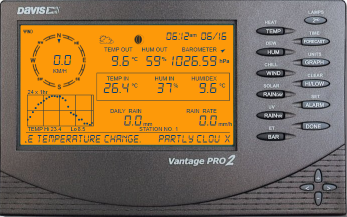
The modern weather station console can display many readings, merely there are considerable benefits from linking your weather condition station to a estimator and experiencing the resulting power and flexibility from viewing via a estimator brandish.
Note that nosotros're using 'figurer' in a broad sense. Computer ways any and all sorts of computer – PC, Mac, Raspberry Pi, web server etc. And the Internet is everywhere nowadays, so the computer could easily be sited remotely (eg in the deject) merely equally it could be sited locally and not continued to the Internet at all. We'll embrace all these different computer approaches in more than detail beneath.
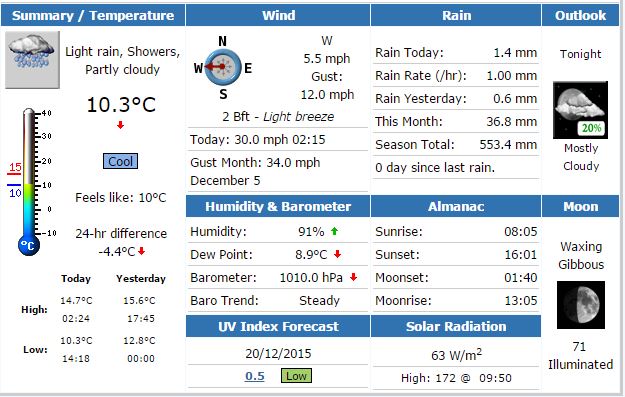
But irrespective of the figurer'due south location, a information logging/software package has to be the number ane accessory for your Vantage Vue or VP2 station. Impressive graphics plus the pick of comprehensive data storage and belittling features genuinely add a new dimension to the ability, usefulness and enjoyment of the station. And automatic uploads to your own live weather website tin add further interest (run across one example right).
Linking a Davis station to a computer, whether local or remote, is easily accomplished past virtually users whatsoever their computer experience. But in that location are several alternative ways to make the computer link and the sheer selection available and the pros and cons of each option tin can be confusing to new users, hence these actress notes. Notwithstanding, one time a determination is made on logger, computer and software, the actual implementation is usually very straightforward.
Important: Enviromonitor: The notes hither cover the Vue and VP2 range of consoles and loggers just. The Davis Enviromonitor (and Connect) stations typically upload data via their gateways straight (and merely) to weatherlink.com mostly via the mobile/cellular phone network and are not explictily discussed here – delight see their respective linked pages for further details. For installation at remote field sites, Enviromonitor or Connect might often be the preferred station type.
Linking the conditions station to a computer can reach many objectives simply it is of import to be articulate about what yous need from the system – the pick of hardware and software needs to exist tailored to your personal or business requirements. Here are some points to consider:
- Computer-linked weather condition stations deliver 2 main types of data: a snapshot of current conditions conditions (sometimes called 'live' weather); and a full summary history or database of all weather readings since the station was first prepare, which can then be charted, summarised and analysed as required. You lot may need both or simply one of these types of data but the optimum computer solution is probable to depend on your choice;
- Where do yous desire to be able to come across the data? Just on a local computer in your home or office? Or accessible across the Internet then that you can view data eg away from home on a smartphone or tablet? Maybe you lot want some combination of the two, eg a full history available on a domicile computer simply current weather attainable remotely on a phone?
- How oft practice you desire the data updated? Some users may exist content to use their console brandish for live weather data and just download historical information to a reckoner eg one time a mean solar day or one time a week. But other users may want their information continuously and automatically updating and besides possibly viewable remotely across the Internet. For continuous updates remember that the calculator must also be switched on 24/7/365. (Just this does not necessarily mean that a big PC or Mac needs to be switched on continuously. Some computer options use unobtrusive and very low-power miniature devices similar enhanced loggers or Raspberry Pi computers which are fine running 24/vii at minimal free energy cost.)
- Are yous planning to utilise simply a standard station with possibly only 1 or two extra sensors added? Or do you lot need the flexibility (maybe for the future) to add multiple sensors and transmitters? Unsurprisingly, multiple sensors are more than enervating on software and you may therefore prefer a Weatherlink Alive unit and WLL-compatible software.
- Annotation that local software programs are frequently merely bachelor for particular operating systems. As usual, Windows PCs tend to have the widest choice of programs and Macs are less well served, with Weathercat existence the just Mac program we'd recommend to new users. (CumulusMX and weewx will both run on Macs – and indeed Linux machines more than by and large – as well and are both skillful programs, but both also need more OSX/Linux familiarity to prepare.) It is a cardinal advantage of cloud platforms like weatherlink.com that they don't intendance most local operating systems or hardware and tin be accessed from any calculator or other device with a modern web browser.
- Are you looking for a relatively simple solution, with graphics etc designed by someone else and requiring minimal ongoing management? Or are you a keen figurer hobbyist who enjoys customising how the data is analysed & presented and who maybe wants to run your own private website?
- What about cost? Are you looking for a solution that's low-cost? Or are you willing to spend a bit more (peradventure £l-150 more) in return for a solution that offers more flexibility, features etc.
- How do you feel about a modestly-priced annual subscription? Some online weather platforms such equally the Davis weatherlink.com and weathercloud.internet operate a so-called freemium model where basic features are free only enhanced features such as total access to your historical data require a subscription. These platforms can provide easily-accessed solutions with powerful features and high-quality graphics, simply you need to be comfortable with the idea of a subscription.
Whatever and all of the features mentioned above are readily available with different kinds of reckoner and Internet linkage, merely it will help to recall through in advance the full general blazon of computer solution that you're looking for.
Here are the central principles for understanding which blazon of estimator link to cull:
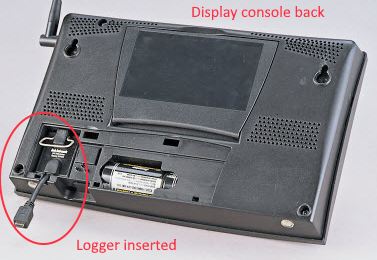 The traditional approach has been to fit a data logger/interface module – usually just called a 'logger' – inside a recess in the back of the console (meet right), with the logger's output directed to a computer, whether local or remote. Once upon a time, at that place was one main road to calculator linkage – fit the panel with a Davis Weatherlink logger (series or USB) and – ordinarily – connect to a PC running the Weatherlink for Windows programme. This choice is certainly even so available but nowadays the choice is much wider and there are now broadly two classes of logger available: the traditional type exemplified by the Weatherlink USB logger; and an enhanced, usually third-political party, logger such every bit the WiFi Logger (WFL) or Meteobridge Nano.
The traditional USB logger does two jobs: information technology provides a standard interface (eg USB) through which both real-time and summary data tin be passed to a computer; and information technology can store summary or annal data pending a download request. The enhanced loggers do both of these two jobs and too provide powerful extra features plus the convenience of WiFi connectivity.
This panel/logger arroyo is still widely used but other options such as the 6100 Davis Weatherlink Live unit offer a newer culling.
For a console logger:
- Be aware that a panel cannot be connected directly to a computer or the Internet – the console raw data output is non in a suitable format. So you lot must accept a suitable add together-on interface fitted to the panel and a standard logger performs this interface function likewise as providing information logging and potentially other functions too.
- Wireless VP2, cabled VP2 and Vue models all take exactly the same logger connector in the panel and so any logger is every bit compatible with all three types of station.
- Notation that the signal from a wireless Vue or VP2 sensor transmitter (eg the standard ISS) can exist received past any number of consoles (provided they're within wireless range of course). If you do have more than one panel and then but i needs to be fitted with the logger and it'southward non uncommon for users to accept their main brandish console in a more 'public' location and with a second panel+logger closer to a calculator or Internet router (though those logger types with WiFi connectivity naturally offer more flexibility for the logger'south location). For cabled VP2 stations there can only be one console and then the logger must exist fitted to that unmarried console.
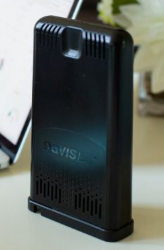 The Weatherlink Live unit (right & see link for total details of its multi-sensor capabilities) is fully independent of whatsoever existing panel and effectively combines the functions of console (though without a display) + data logger. Its WiFi capability too allows the Weatherlink Live maximum flexibility in location.
NB The data output from Weatherlink Live provides a new-generation format which has many advantages but is very dissimilar from older logger types. So any software to be used must be specifically compatible with Weatherlink Live. Another comparable third-party device which is also an independent self-contained VP2 wireless receiver is the Meteobridge Pro Reddish unit (included for completeness but less relevant to new users).
Depending on the linkage device, the connexion to the figurer or network will be one or more of: a unproblematic cabled USB connection; a cabled Ethernet network connection; or a WiFi link.
So, to reiterate, the data output to be sent to the external estimator tin can come from i of 2 types of source:
- A logger installed inside a console and providing data in a suitable format for the figurer;
- A wireless receiver/information-processor independent of a console, similar Weatherlink Live (or Meteobridge Pro Red);
Computer configurations
It's convenient to divide upwardly the type or location of the external figurer into three categories:
- Combined with the logger in a module that nonetheless fits inside the console and referred to here equally an enhanced logger;
- A standard PC or Mac or laptop just broadly any type of local reckoner, including SBC (miniature Unmarried Board Computers) devices similar the Raspberry Pi;
- A remote server or other computer type accessed across the Net and therefore 'in the cloud';
It's important to realise that these three types are not mutually exclusive. It is perfectly possible, and indeed may frequently be desirable, for data from a single weather station to be used and stored both locally and online. (How this is really achieved is covered in more particular elsewhere.) Data availability across the Internet using conditions platforms in the cloud like weatherlink.com and Weather Underground means that your information can in principle exist viewed from anywhere in the earth either past the possessor when abroad from habitation or by others (with permission) and on any device with a web browser or eg smartphone/tablet with a suitable app. On the other hand, many users will still prefer the actress flexibility and control that comes from storing and analysing data locally. It is relatively easy to accept the best of both worlds, if y'all wish, but there are pros and cons to each detailed configuration, which these notes will hopefully assist to clarify.
The schematic below illustrates the range of possible logger configurations.
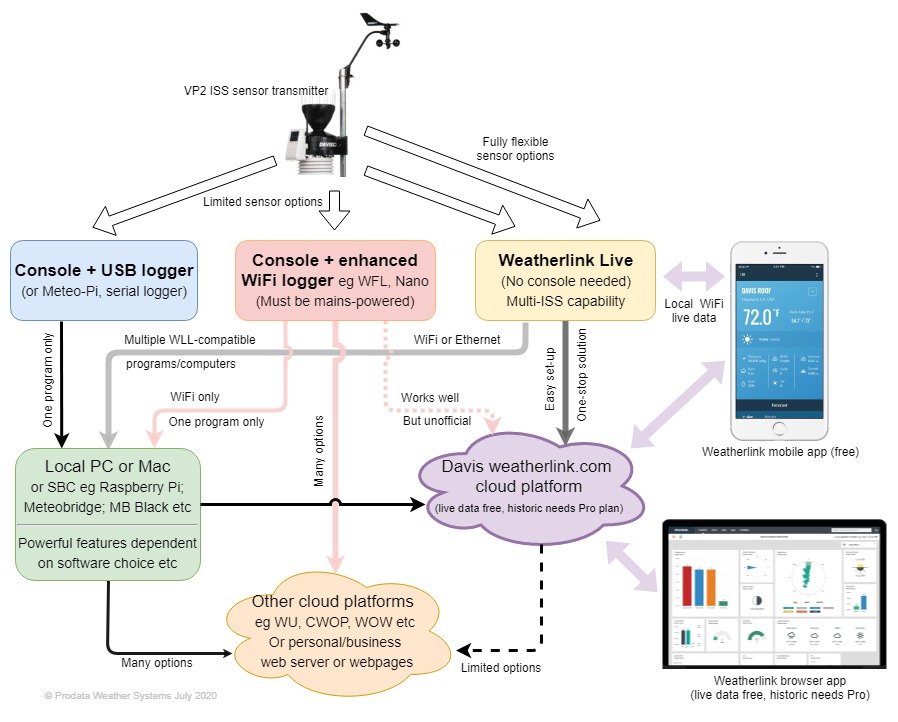
NB This schematic is illustrative only – some features and subtleties volition depend on the item device and software being used. And there are 1 or ii less common options non shown here. Note in particular:
- USB-blazon loggers can pass data only to a local computer and only to one single program running on that calculator. However, that ane program can take many features and potentially provide all the information-handling that some users need;
- The features potentially on offer from software running on a local computer are likewise many to exist detailed or illustrated here and certainly far more than extensive than the unmarried green box may propose. Please refer to the feature-ready of individual programs available for different estimator types for farther details;
- Weatherlink Live is a wireless receiver in its own right. So it can be used as the only receiver in a station or volition coexist happily alongside other console/receivers;
- Weatherlink.com is the only cloud platform to which Weatherlink Live units are able to upload information directly (indirect uploads are possible using a local computer every bit well or, alternatively, forwarded from weatherlink.com). As shown, Weatherlink Alive can also pass data to other uniform software programs;
- Uploads to weatherlink.com from enhanced loggers like WFL and Nano are shown dotted and 'unofficial' considering these are not formally sanctioned by Davis (the owner of weatherlink.com). That said, the uploads work well and to appointment there is no sign at all that Davis are unhappy with these extra information uploads;
- Data connections from enhanced loggers to local computers are beyond the network (ie WiFi) only. And so enhanced loggers can be thought of as network loggers. USB-type cabled connections must utilise a traditional USB logger;
- Browser and mobile apps are shown for the weatherlink.com platform. Comparable apps may be available for some other cloud platforms.
- A Weatherlink Live unit can receive ANY combination of transmitters & sensors on all 8 available wireless channels. In dissimilarity, the more constrained 'limited sensor options' receivable by a standard VP2 wireless panel are as shown below:
- A single ISS or Plus ISS;
- Multi-sensor transmitters (6332) each fitted with a single sensor. Only certain combinations are allowed, eg 1 anemometer per station only; upwardly to 2 or three temperature or T/H sensors (one per transmitter of grade); but no other boosted sensors, eg pelting estimate and solar/UV must be attached to the main ISS and not to a 6332 transmitter. One 6332 transmitter cannot exist fitted with more than than one sensor and still exist receivable by a VP2 console. (T/H counts as a single sensor.) NB The old (now discontinued) 6372 and 6382 T and T/H supplementary transmitters were effectively a 6332 transmitter plus a T or T/H sensor sold every bit a unmarried package;
- A single 6345 soil moisture etc transmitter and fitted with any allowed combination of soil wet, leaf wetness & T sensors;
- NB A Vue panel receives simply a standard Vue or VP2 (including Plus) ISS and, optionally, a single anemometer transmitter, but naught more. A cabled VP2 panel tin receive data only from one unmarried cabled VP2 ISS;
Note: The Davis 6555 WeatherlinkIP logger does not announced in this scheme because information technology is now a discontinued product. But the 6555 would have classed as an enhanced/network logger with a cabled network connectedness (just) and uploading simply to the weatherlink.com cloud platform.
The flexible choice of logger types plus the many computer and software options means that data-treatment solutions can exist tailored to a wide range of data requirements and user expertise. That said, in that location are some common requirements for which nosotros can offering some specific recommendations:
- A Weatherlink Live unit of measurement uploading to the weatherlink.com platform is ideal for those looking for easily-installed data handling with atmospheric condition readings accessible from anywhere via the Internet and with minimal management needed by the user. Weatherlink.com is already a powerful platform and continues to add new features almost month by month. Remember that a subscription is required if you lot want weatherlink.com to provide access to your historical information (simply viewing current weather data is free).
- Users happy with the console display for seeing current atmospheric condition merely wanting to download summary data to eg a laptop on say a weekly basis (ie no computer attached 24/7) for long-term storage will probably be content with a simple USB logger connecting to either a Windows or Mac laptop and running software like Weatherlink for Windows or Weathercat (Mac).
- The about straightforward and cost-constructive solution for users wishing to upload data to multiple online platforms (Weather condition Clandestine, Weathercloud, weatherlink.com etc) and with less involvement in local data handling will probably exist an enhanced logger – either WiFi Logger (simpler & cheaper) or Nano (college-priced, but fifty-fifty wider choice of upload platforms and other avant-garde features).
- Users looking for a good balance of convenience, ease-of-use and moderate cost in a local arrangement running 24/vii could consider either a USB logger (simpler only cabled) or WiFi Logger (convenience of WiFi) linked to a computer running maybe CumulusMX or Weather Display. (A Weatherlink Live unit of measurement would exist an alternative to a logger and would provide extra sensor flexibility but at slightly higher price and with more limited choice of software.)
- For maximum plan power and features, the suggested options are a Meteobridge version such every bit Nano SD or a computer (Raspberry Pi?) running weewx. Note that weewx does demand somewhat more computer experience to take full advantage of its features, though step-past-step how-to guides are bachelor.
To repeat: the above are but examples of typical use-cases. Information technology is absolutely possible for new users to selection whichever logger type and combination of reckoner and software or platform comes closest to meeting their own requirements for cost, ease-of-employ, features etc.
NB The description of classic Weatherlink which used to occupy this page can now exist found hither.
Source: https://www.weatherstations.co.uk/pc_linkage.htm
0 Response to "Mac Davis Vantage Pro Weather Underground Upload"
Post a Comment