Do Instant Pots Go on Sale Again After Black Friday
In a remarkable show of force and unity, western powers bandage aside all their previous concerns about Russian energy export authorisation, and uniliaterally announced the nuclear option of imposing sanctions on the Russian central depository financial institution coupled with targeted exclusions from SWIFT of central Russian banks.
- *European union APPROVES BANNING ALL TRANSACTIONS WITH RUSSIAN Key Banking company
The move has sparked a depository financial institution run in Russia, as locals scramble to pull out whatever difficult currency they can get their hands on before information technology runs out, and is sure to trigger chaotic moves in FX and commodities when markets reopen on Mon. Already some Russian banks are offer to substitution rubles for dollars at a charge per unit of 171 rubles per dollar on Dominicus, compared to the official closing price of 83 on Friday before the European/US declaration nigh targeting the Russian central bank. In other words we are looking at a 50%+ devaluation of the Ruble. Additionally, widespread announcements of divestments in Russian equities by the likes of BP pls and the Norwegian sovereign wealth fund mean that the Russian market will be a bloodbath on Mon.
Every bit Bloomberg notes, bolt are as well heading for a manic start to the week as investors scramble to assess how the West's latest sanctions on Russian federation will affect flows of energy, metals and crops.
The coming days are fraught with issue take chances for crude, fifty-fifty aside from the sanctions fallout. There's a midweek coming together of OPEC+ on output; the Biden administration may tap stockpiles; and Iranian nuclear talks look to be nearing a conclusion. On height of that, American rough inventories at the central Cushing hubcould sink to the lowest since 2014 if there'southward another pocket-size depict.
Meanwhile, Goldman Sachs said that despite the rally in prices, it'due south unlikely OPEC+ volition choose to quicken the stride at which the alliance has been restoring supplies, citing Russian federation's "essential role" in the grouping.
And while Europe's moment of unity is certainly inspiring, it doesn't reply the question simply how the continent will replace the massive amount of energy that menstruum every unmarried day via the endless Russian pipelines into Europe, which are now for most intents and purposes shut.
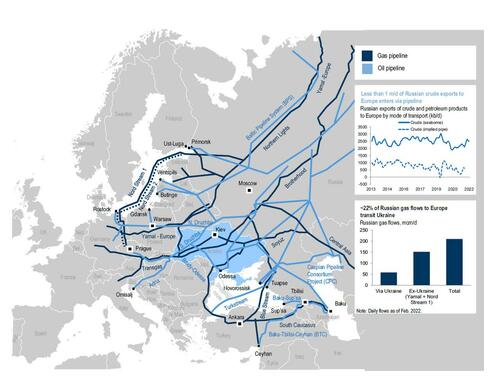
But a bigger question, and one which has so far not been pursued, is what happens to the western financial organization as a upshot of the sudden expulsion of Russia - and its billions of dollars - from the global monetary system.
One somewhat dire take comes from Bear Traps report writer Larry McDonald who writes overnight that we need urgently to know what is actually sanctioned here: "They - Olaf - Macron - Biden - volition try and dance around risk with a targeted swift but they're probably not qualified to do and so" calculation that "Information technology's like a Lehman weekend with clueless politicians trying to discover gamble in the nighttime."
"If they sanctioned the primal banking company and the transfer agents for Eurobonds then Russia will default on all foreign debt immediately. And if Russian federation tries to find a back door through China we volition fine or sanction Chinese banks. Another thing, Federal republic of germany can play swift tough guy but Macron has to protect most vulnerable Soc Gen and Draghi is probably trying to protect vulnerable Italian banks like intesa."
While that take may be a bit extreme equally it presupposes Europe has rushed into the wholesale sanctions without whatever backup plans, a more nuanced take comes from Credit Suisse repo guru and monetary plumbing expert, Zoltan Pozsar, who took a detour from his extensive narrative of how the Fed's QT volition impact the market and instead focuses on what could be a "Lehman weekend" for funding markets as a consequence of Western sanctions on Russia which equally Zoltan notes is a "surplus agent" - i.e., an entity which typically lends a lot of funds in the Eurodollar marketplace. The Bank of Russian federation has over $450 billion in not-gilt FX reserves, and the private sector has over $500 billion of liquid investments as shown below
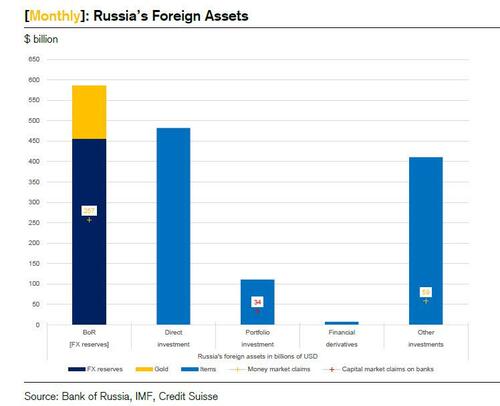
First, some background on where Russian central depository financial institution assets are located
Every bit shown in the chart below, of Russia's close to $1 trillion of liquid wealth, just over $300 billion is in short-term money market place instruments, and Pozsar estimates that almost $200 billion of this represents the lending of United states of america dollars in the FX swap marketplace.
This, nevertheless, is non immediately obvious from the Banking company of Russia's reports, which as the Credit Suisse strategist notes don't mention FX swaps and list merely about $100 billion in US dollar exposures. As such, Pozsar cautions that the published numbers require careful interpretation: Thus, co-ordinate to the Bank of Russia'south latest Foreign Exchange and Gold Asset Direction report, U.S. dollar assets made up virtually 20% of Russian federation's non-gold FX reserves at the end of June 2021, which is mode down from 50% at the stop of March 2018
Every bit a reminder, in April 2018, Russia sold all its cash Treasury securities – both the central banking company and the private sector – but every bit Zoltan notes, there are tell-tale signs in the data that the proceeds from these sales went into the FX swap market place. In other words, "FX reserves are still in U.S. dollars, but not onshore. They are offshore in the Eurodollar market."
As further proof that Russian reserves accept entered the swap market place, Pozsar notes a substantial increment in Russia'due south claims on foreign primal banks subsequently it sold U.S. Treasuries (see chart belowe), adding that on-residue sheet manifestations of FX swaps (the spot sale and forward purchase of U.S. dollars for other currencies) are non-U.S. dollar assets that the lender of U.S. dollars buys with the local currency collateral received against U.Due south. dollars: "For central banks, these are typically deposits at other central banks."
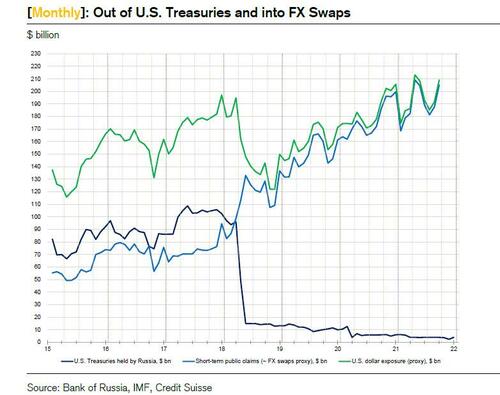
Chasing the trail of where Russian fundamental bank reserves tin be found, Figure three shows the big increase in the Bank of Russian federation'due south claims on strange key banks and the typical year-terminate spikes that come as lenders in the FX swap market place lend more to harvest year-end funding premia: "In recent years – because QE during the pandemic compressed dollar premia – the data likewise shows a shift in the reinvestment strategy toward short-term debt issued by supranationals." The chart above shows Zoltan'due south estimate of the Banking company of Russia's U.Due south. dollar exposure with adjustments for dollars lent through FX swaps. The share hasn't much changed since 2018 – it's still about 50%, which is more reasonable than the reported 20% for a country that is a big exporter of commodities priced in U.S. dollars.
Assuming that Russian federation has roughly $200 billion in FX swaps, the Hungarian repo skillful then points the Bank of Russian federation and the private sector have claims on strange banks in the form of deposits in the amount of about $fifty billion each – likely a mix of euro- and U.Southward. dollar- denominated deposits, which is how Zoltan arrived at the $300 billion total to a higher place.
Market Bear on of Sanctions
If Russian curt-term coin market instruments are roughly 30% of its total liquid wealth of $1 trillion, as the above calculations suggest, Zoltan and then warns that "$300 billion deployed in the money markets is a lot. $300 billion is enough to push spreads around in funding markets." He then goes on to annotation that "$300 billion – in the extreme – can either exist potentially trapped by sanctions, or moved somehow from W to East to avert being trapped past sanctions. Each would be a market issue."
What happens if the funds get frozen through sanctions – an event which the CS annotator says "would turn a surplus agent into a deficit amanuensis, which in turn would lead to missed payments, much like the onset of Covid-19 led to missed payments and turned surplus agents into arrears agents."
The downside case if indeed this is similar to the start of Covid when overnight trillions in brusque-term funding markets were frozen, is something the marketplace should discount according to Pozsar. Alternatively, as he explains it more simply, "consider the notion that if y'all owe the banking concern $1 million, that'southward your problem, but if you owe the bank $1 billion, that's the banking company's trouble."
One potential loophole Russia has is that equally surplus amanuensis, it tin can move surplus funds from Western financial centers and institutions to financial centers, financial institutions, and fundamental banks elsewhere (i.e., in the east, such equally Red china ) that would then re-cycle surpluses back into the financial organisation.
However, that would hateful the partial "tear-up" of matched FX swap books and outflows of operating deposits (equally public and private surpluses are moved, respectively) from Western banks. But that would exist their funding trouble – as arrears agents, these institutions may then accept to tap the dollar swap lines.
And here things start getting ugly, considering as Pozsar puts it, "when flows change, spreads can gap."
Escalation and central bank response
Conceding ahead of the weekend'south escalation that he is no expert on geopolitics, nor does he know which style events will unfold either on the ground or in the domain of sanctions, Pozsar cautions that "if things escalate, information technology'due south hard not to see a direct bear on on FX swaps and U.South. dollar Libor fixings given Russia's vast financial surpluses and where those surpluses are deployed." Or as he put it "
Whoever moves offset, there is a funding affect either style…"
Which brings united states of america to Pozsar's latest must read annotation (bachelor to professional person subs), which was published after nosotros learned that the Russian central bank will be sanctioned effectively triggering the worst case scenario for funding markets, and in which Pozsar writes that "I'll never forget the late-night briefing on Friday before Lehman's bankruptcy where according to 1 line of argument Lehman's problems were so widely understood that the system had enough time to hedge itself so that the actual default would be manageable." Well, as he sarcastically notes, "It didn't turn out like that" adding that "if a bank closes a $200 billion balance sail on Fri and doesn't open on Monday, someone'south $200 billion wasn't hedged past definition."
The aforementioned applies with exclusions from SWIFT. Co-ordinate to Pozsar, exclusions from SWIFT "will lead to missed payments and giant overdrafts similar to the missed payments and giant overdrafts that we saw in March 2020."
As a reminder, dorsum and so Zoltan was perchance the first to warn - loudly - that "supply chains are payment chains in reverse" and that lockdowns would pb to missed payments everywhere. Today, all global payments go through SWIFT (including payments for commodities) and so the Credit Suisse strategist notes that "exclusions from SWIFT will lead to missed payments everywhere once again" or as he puts information technology, "Just as covid virus froze the menstruum of goods and services that led to missed payments, war has led to exclusions from SWIFT that will atomic number 82 to missed payments once again.... But by blueprint, and not without a risk of retaliation: if a freeze in activeness can lead to missed payments, an inability to receive payments through SWIFT tin can freeze the menses of goods, services, and bolt like gas or neon in kind.
Beingness a budgetary plumbing expert, Pozsar is in his prime to warn that "we are dealing with pipelines here – financial and existent. In the nowadays context, they are two sides of the same coin. Disability to receive may hateful unwillingness to send. Commodity flows aside, one would assume that key banks would re-actuate daily swap line operations now that the SWIFT option got invoked.
In other words, central banks should stand up ready to brand markets on Monday again .
Equally an bated, the Russia central banking concern appears to have anticipated at to the lowest degree a part of the electric current escalation, because as noted to a higher place, "the Bank of Russia (BoR) has neither Treasuries to repo with the new FIMA repo facility, nor dollar swap lines with the Fed, and if its assets are frozen, it can't raise dollars to provide for its domestic banks." Information technology does, still, have swap lines where the rehypothecation pathway can exist severed... and it as well has lots of gold.
Why does that matter? Well, as Pozsar explains in a quick crash course on "moneyness", central bank deposits, bank deposits, and securities are all "within money" – that is, money and money-like claims that are someone else'due south liability – and it's situations like this when "outside coin" – coin claims similar gold bullion that are no 1'southward liability – is rex, especially if stored in vaults domestically. Unlike balances at the Deutsche Bundesbank, western G-SIBs, or Euroclear, you control what you accept.
The best example of grade is Gold, which is a sovereign'due south money under the mattress, and equally Pozsar notes, "the Bank of Russia has more of it than deposits at foreign central banks!"
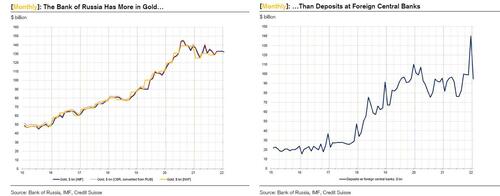
The silver, or rather golden lining for Russia, is that gold tin can be pledged under repo operations to cover one'southward dollar needs (something which both Venezuela and Turkey have done) with a willing, collateral-rich primal bank that has enough Treasuries to repo (such as Mainland china), or maybe even the BIS (which owes its origin to reparation payments), and one can accumulate dollar surpluses anew through ongoing commodity exports away from financial centers in the Due west by seeding financial centers in the East.
Indeed, Equally Pozsar puts information technology, "the options appear limitless", as long equally there is a willing counterparty to transact with Russian federation:
- U.S. dollars from Treasuries via repos.
- U.S. dollars from local currency via FX swaps.
- U.S. dollars from gold via whatever we'll end up calling that...
Simply this is where the repo plumbing guru warns again that such "transitions are never smooth" especially since "banking is about double entry accounting: My assets are your liabilities like the blue and red veins in a trunk in one's elementary biology volume."
Lehman weekend 2.0
Which brings the states to the punchline of Pozsar'southward warning: "there is no divergence between Lehman unable to pay dorsum money funds because its tri-party clearing amanuensis is unwilling to unwind o/n repo trades, and banks unable to receive and make payments because they are out of SWIFT." He and so adds that the Herstatt run a risk – or settlement take chances – owes its proper name to a mishap at a unmarried bank, but "the risk in the current scenario involves an entire country'south banking arrangement."
And hither comes Pozsar with another Lehman illustration:
Banks' inability to make payments due to their exclusion from SWIFT is the same as Lehman'southward inability to make payments due to its clearing bank'due south unwillingness to send payments on its behalf. History does non repeat itself, but information technology rhymes…
The lesser line from Pozsar, and ane which western leaders appears to have ignored in their pursuit of a unified statement against Russian federation, is that "the consequence of excluding banks from SWIFT is real, and so is the need for cardinal banks to re-activate daily U.Due south. dollar funds supplying operations."
And just to underscore the betoken of how serious it will become in the coming hours (not days), the Hungarian warns that "excess reserves and o/due north RRP balances won't be enough." Instead, we will see the Fed's most powerful stabilizing intervention in play: a fasten in liquidity swaps, which are currently at nothing.
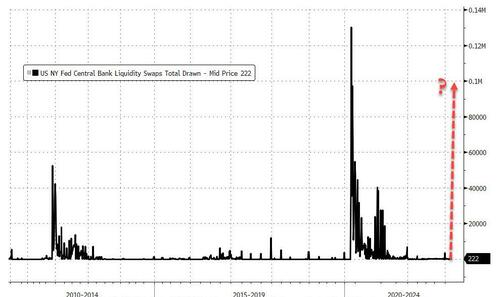
Every bit Pozsar concludes, it appears that the Ukraine war has translated into yet some other Fed balance sheet-boosting crisis just similar covid, and "so the Fed's balance sheet might aggrandize again before information technology contracts via QT – and not just because of the bandy lines. The FIMA repo facility is as well there to turn collateral into dollars – anonymously, away from the prying eye of dealers, if a central banking company becomes a friendly correspondent for a sanctioned fundamental banking concern turning gold into cash."
That, or an unforeseen call on unwanted reserves in the o/n RRP facility as the correspondents flood the repo market with collateral before QT even began.
And just similar that nosotros are back to foursquare one: keep an center on press releases from the Fed alee of Mon'south open announcing the fundamental bank'due south readiness to keep the earth flush with dollars as the Ukraine worst-case scenario is now reality.
The full Pozsar notes are bachelor to professional subs in the usual place.
Source: https://www.zerohedge.com/markets/pozsar-warns-another-lehman-weekend-russia-sanctions-may-trigger-central-bank-liquidity
0 Response to "Do Instant Pots Go on Sale Again After Black Friday"
Post a Comment